
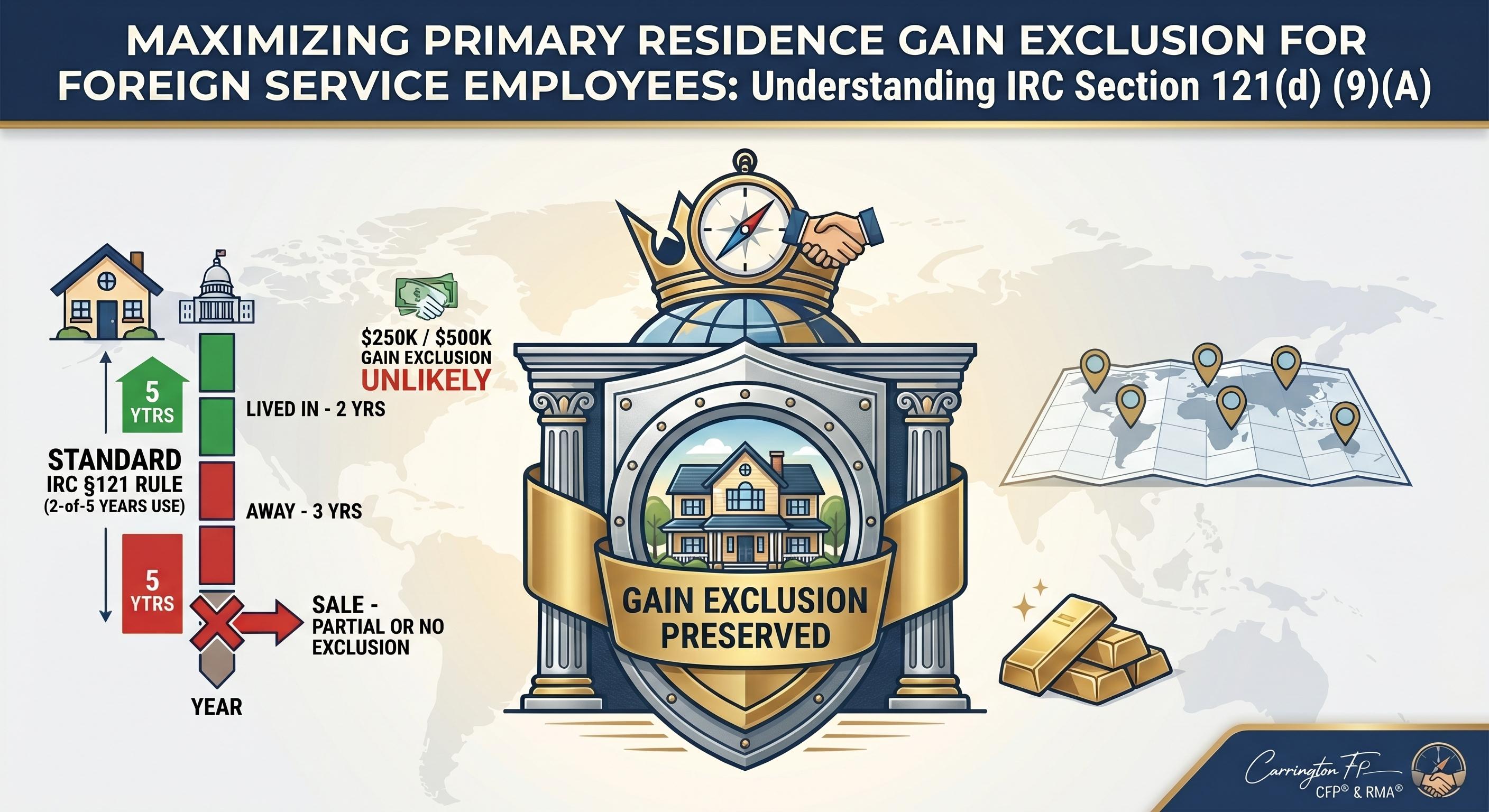
Section 121(d)(9): The Capital Gains Exclusion Extension Every Foreign Service Employee Should Know
If you're a Foreign Service employee who owns a home in the United States while serving overseas, there's a provision of the Internal Revenue Code written specifically for you — and it can save you tens or hundreds of thousands of dollars in tax when you eventually sell. It's called Section 121(d)(9), and it allows qualifying Foreign Service employees to extend the capital gains exclusion on a primary residence sale by up to 10 years beyond what's available to ordinary homeowners.
Most Foreign Service employees we work with have heard of "the exclusion" but don't know the mechanics, the limits, or how to elect it properly. Here's how it works.
The standard rule, first
Section 121 of the Internal Revenue Code lets you exclude from federal income tax the gain on the sale of your primary residence — up to $250,000 if you're single, $500,000 if you're married filing jointly. To qualify, you must have owned and used the home as your primary residence for at least 2 of the 5 years before the sale.
For most homeowners, this works cleanly: live in your house for at least two years out of any rolling five-year window, and the exclusion is yours.
For Foreign Service employees, the standard rule creates a problem. A typical overseas tour runs two to three years, and a career of back-to-back overseas assignments can easily push you past the five-year window. If you bought a home in Arlington in 2003, lived in it through an early domestic assignment, then spent the following decade posted abroad, the standard rule would make your entire gain taxable on sale — even though you're overseas because the government sent you there.
This is exactly the situation §121(d)(9) was written to solve.
What the statute actually says
The relevant text of §121(d)(9)(A):
"The running of the 5-year period shall be suspended during any period that such individual or such individual's spouse is serving on qualified official extended duty [as a member of the Foreign Service of the United States]."
And §121(d)(9)(B):
"The 5-year period shall not be extended more than 10 years by reason of subparagraph (A)."
That's the whole mechanism. The five-year clock stops running during qualifying overseas duty, for up to 10 years total.
What "suspended" means in plain language
This is where people get confused. The statute doesn't extend the five-year window by tacking extra years onto the end. It suspends — pauses — the clock entirely during overseas service. Overseas years simply don't count toward the five-year period at all.
Think of it as a stopwatch that measures the five-year window running backward from your sale date. Normally the stopwatch runs continuously, capturing five consecutive years. With §121(d)(9), the stopwatch pauses whenever you're on qualifying overseas duty. The clock keeps running backward through time, skipping over your overseas tours, until it accumulates five years of non-overseas time.
The practical result: the five-year window can span up to 15 calendar years — five years of actual clock time plus up to 10 suspended years — but you still only need to have lived in the home for 2 of those 5 clock-years.
A worked example
Sarah buys a home in Arlington in 2003 and lives there for three years, from 2003 through 2005. In 2006 she goes overseas on the first of several assignments, serving abroad for eight consecutive years through 2013. She returns to the US in 2014 and sells the home in 2015.
Without the §121(d)(9) election: The standard five-year lookback covers 2010 through 2015. Sarah was overseas from 2006 through 2013 and not living in the home during any of that period. She doesn't meet the two-year use requirement. The full gain is taxable.
With the §121(d)(9) election: Sarah elects to suspend the clock during her eight years of overseas service (2006–2013). Those eight years don't count. The clock now runs backward from 2015, skips over 2006–2013, and continues back through 2005, 2004, and 2003. Sarah's three years of residence (2003–2005) fall squarely within the effective window. Three years of use clears the two-year threshold. The exclusion is available — up to $500,000 of gain is excluded if she files jointly.
This example closely mirrors the IRS's own illustration in the Treasury regulations at 26 CFR §1.121-5. The IRS's version uses identical mechanics; the result is the same.
Who qualifies for the suspension
To elect the suspension, you must be serving on "qualified official extended duty" as a member of the Foreign Service of the United States, as defined by the Foreign Service Act of 1980. This covers Foreign Service officers, specialists, and other categories within the meaning of that Act.
The duty must meet one of two conditions: you're stationed at a duty station at least 50 miles from the home, or you're required to reside in government quarters under government orders. Almost all overseas Foreign Service assignments satisfy one or both conditions.
The duty must also be for more than 90 days or for an indefinite period — routine overseas posts qualify easily.
The provision also applies to uniformed services members and employees of the intelligence community, so a Foreign Service employee married to a military member, for example, may be able to elect based on the spouse's qualifying duty.
The election: how it works
The §121(d)(9) election is not automatic. You make it by filing a tax return for the year of the sale that does not include the gain in your gross income — in other words, by claiming the exclusion. There is no separate form. The election is made by how you report (or don't report) the gain.
Two rules worth knowing: the election is limited to one property at a time (you cannot suspend the clock on two homes simultaneously), and it can be revoked at any time.
Documentation matters. If the IRS questions the exclusion, you'll need to demonstrate qualifying overseas duty during the suspended period. Foreign Service assignment records, cable authorizations, and State Department personnel documentation generally suffice.
Traps to avoid
The 10-year cap is firm. Foreign Service employees with more than 10 years of consecutive overseas service cannot suspend the entire overseas period — the cap is 10 years. The math must be run carefully if your overseas tenure is long.
Depreciation recapture is separate. If you rented the home and claimed depreciation while overseas, that depreciation is subject to recapture at sale regardless of the §121 exclusion. The exclusion protects capital gain; it does not shelter depreciation recapture income.
The once-every-two-years rule still applies. If you excluded gain on another home within the two years before this sale, you may not be eligible.
Foreign and state tax may still apply. Section 121(d)(9) is a federal income tax provision. If you're a tax resident of a state that has its own capital gains rules, or if you sell while stationed in a country that taxes US property dispositions, separate analysis is required.
Planning takeaways
For Foreign Service employees who've owned a US home and accumulated significant equity over a long overseas career, §121(d)(9) can be one of the most valuable tax provisions available. The key planning question is timing: if your overseas service is approaching or has exceeded the 10-year suspension cap, the clock is running out — and the sale date starts to matter a great deal.
The election is also worth knowing well before you need it. Many Foreign Service employees discover it only when they're already in the process of selling, leaving little room to optimize. Understanding the window early means you can make deliberate decisions about when to sell, whether to rent in the interim, and how the home fits into the broader retirement income picture.
Carrington Financial Planning is the fee-only fiduciary financial advisor for U.S. Foreign Service employees and other federal employees. We help clients navigate financial planning decisions unique to Foreign Service careers — including §121(d)(9) timing, retirement scenarios, and overseas financial planning. To discuss your situation, schedule a free consultation.
This article is for educational purposes only and does not constitute tax or legal advice. Section 121 is a complex provision with significant individual variation; please consult a qualified tax advisor before relying on the §121(d)(9) election in your specific circumstances.