
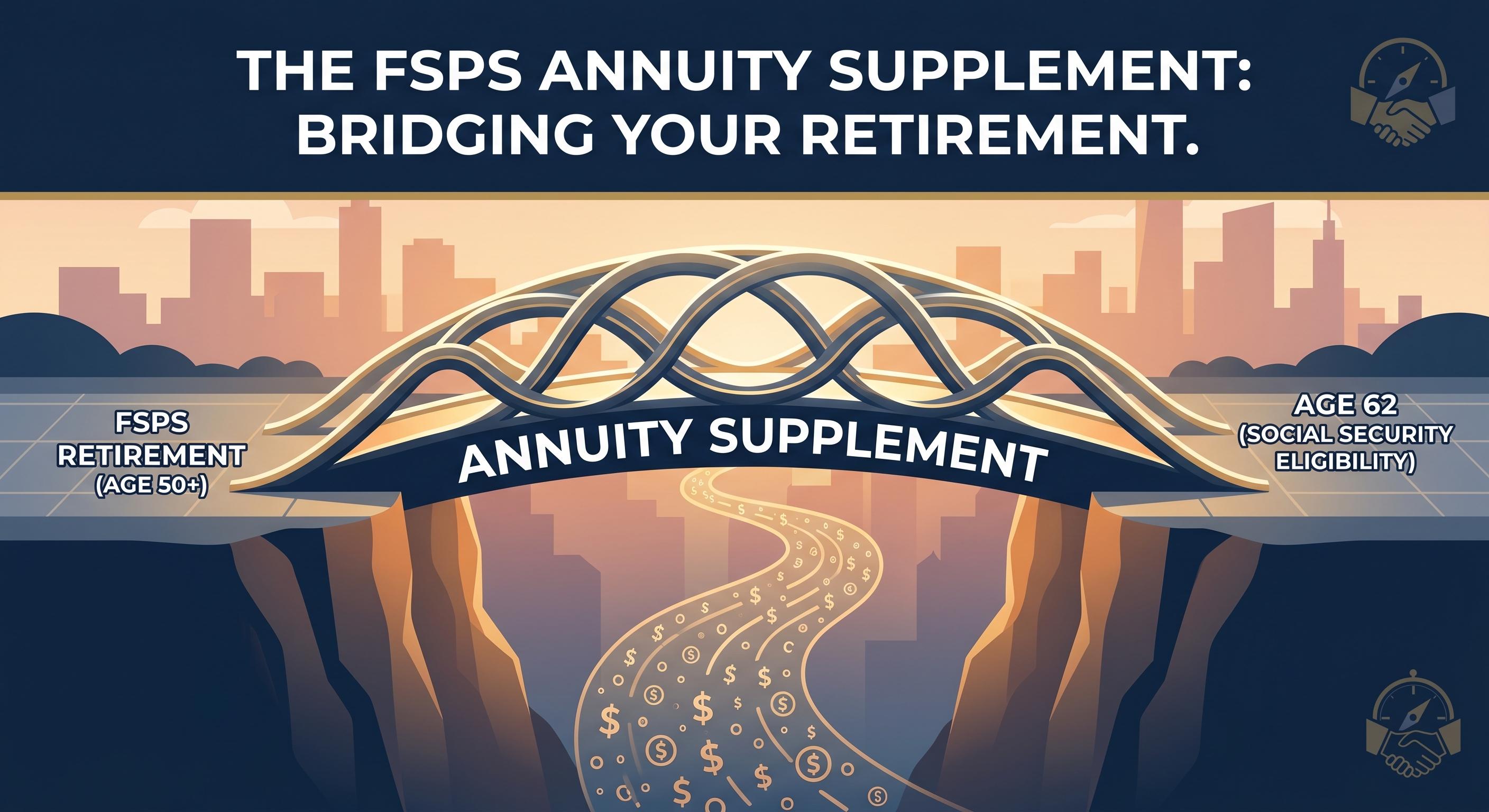
The FSPS Annuity Supplement, Explained: How the Bridge to Social Security Works for Foreign Service Retirees
For Foreign Service officers retiring before age 62, one of the most valuable — and most misunderstood — components of the FSPS retirement package is the Annuity Supplement. It's the bridge that fills the gap between your retirement date and the day you become eligible for Social Security. If you're approaching retirement, understanding how the supplement is calculated, how long it lasts, and how the earnings test works will materially shape your decisions about when to retire and whether to take post-retirement work.
What the Annuity Supplement is
The Foreign Service Pension System (FSPS) Annuity Supplement is a payment from the Office of Personnel Management (OPM) to FSPS retirees who leave service before age 62. It approximates the portion of your eventual Social Security benefit that you earned through your Foreign Service career. In effect, it lets OPM hand you an "early Social Security" payment so that your retirement income doesn't drop in the gap years before you can actually claim Social Security at 62.
The supplement is paid in addition to your basic FSPS annuity (the 1.7% × high-3 × years of service calculation), not in place of it. It is not a separate election — it's automatic for FSPS retirees who qualify.
Who qualifies
You're eligible for the Annuity Supplement if you retire under one of the FSPS provisions that pays an immediate, unreduced annuity before age 62. The most common qualifying scenarios for Foreign Service personnel are:
- Mandatory retirement at age 65 (the standard FSPS path for most FSOs)
- Early retirement under the special category provisions for Diplomatic Security and other designated categories — typically retirement at age 50 with 20 years of service
- Retirement at any age with 25 years of service, where the retirement is involuntary or under specific provisions
The supplement is not paid to those who take a deferred annuity, who separate without immediate retirement, or who retire under the FERS rules (a distinction that matters for Foreign Service spouses serving as EFMs at post — covered separately).
How it's calculated
The formula is straightforward in principle:
Estimated Social Security benefit at age 62 × (Years of FSPS service ÷ 40)
OPM estimates what your Social Security benefit at age 62 would be based only on your federal earnings — not your full SS earnings record — and then prorates that amount by the fraction of a "full" 40-year career you've spent in FSPS-covered service.
A simplified example: if your estimated age-62 SS benefit (based on FSPS earnings) is $2,000 per month, and you retire with 25 years of FSPS service, your annuity supplement would be approximately $2,000 × (25 ÷ 40) = $1,250 per month. The actual calculation uses OPM's specific methodology and rounds at various points, but the proration concept is what drives the result.
Two important features the formula obscures:
- The supplement is not COLA-adjusted. Unlike your basic FSPS annuity, the supplement does not increase with inflation. Whatever amount you start with at retirement is the amount you receive each month until it ends.
- It is taxable as ordinary income. Federal tax applies; state tax depends on your state of residence.
When it ends
The Annuity Supplement stops the month you turn 62. It stops whether or not you actually claim Social Security at that age. Many retirees mistakenly believe they can defer Social Security to 70 and continue receiving the supplement — they cannot. If you defer SS past 62, you will have a gap with no supplement and no SS until you claim.
This timing makes Social Security claiming strategy a meaningfully different decision for FSPS retirees than for most Americans. The break-even math for delaying Social Security has to be evaluated against losing the supplement at 62, not against starting from zero.
The earnings test (where most retirees get tripped up)
If you take post-retirement employment, the Annuity Supplement is subject to the same earnings test that applies to early Social Security claimants. For 2026, the exempt amount is $24,480 in earned income. For every $2 you earn above that threshold, $1 is withheld from your supplement.
A few things worth knowing:
- The earnings test applies only to wages and self-employment income. It does not apply to investment income, rental income, pension payments, TSP withdrawals, or other unearned income.
- The reduction applies to the supplement only, not to your basic FSPS annuity. Your underlying pension is unaffected.
- The earnings test does not begin until you reach your Minimum Retirement Age (MRA). For most FSOs taking mandatory retirement at 65, this is moot — you're already past MRA. For special category employees retiring at 50, the supplement is exempt from the earnings test until they reach MRA, which is a meaningful planning advantage.
- Unlike Social Security's earnings test, amounts withheld from the supplement are not later restored. They are simply lost.
The practical implication: if you're a special category retiree planning a post-retirement consulting career or second-act job, the earnings test won't bite until your MRA. If you're a standard FSPS retiree at 65 already past MRA, post-retirement earnings can erode the supplement quickly.
Common planning questions
Should I take a job in retirement that exceeds the earnings limit? The math depends on the value of the supplement to you, the after-tax value of the work income, and how long the job will last. We model this for clients on a case-by-case basis. The earnings test is not a reason to avoid post-retirement work — it's a factor to price in.
Can the supplement affect my Social Security benefit later? No. The supplement and Social Security are separate programs. Receiving the supplement does not increase or reduce the SS benefit you eventually claim.
What if I'm widowed or my spouse retires before I do? Survivor and spousal interactions are handled separately under FSPS and FERS rules. The supplement itself does not provide survivor benefits — it ends with the retiree.
Planning takeaways
The Annuity Supplement is more valuable than its monthly dollar figure suggests, because it arrives during the highest-leverage years of retirement: the gap between your retirement date and Social Security claiming age. Decisions about retirement timing, post-retirement work, and Social Security claiming should be evaluated together, not in isolation. The supplement is also one of the strongest arguments for retiring at the FSPS-eligible age rather than continuing to work — many FSOs underestimate how much they're forgoing by staying in service past their eligibility date.
Carrington Financial Planning is the fee-only fiduciary financial advisor for U.S. Foreign Service officers and federal employees. We've helped more than 1,000 Foreign Service professionals plan their financial futures, from A-100 through retirement. To discuss your retirement timing and the Annuity Supplement in the context of your full financial picture, schedule a free consultation.
This article is for educational purposes only and does not constitute tax, legal, or investment advice. Federal benefits rules are complex and individual circumstances vary; please consult a qualified advisor or OPM directly before making decisions based on this information.