
A Dividend Isn't Extra Money: What Really Happens When a Fund Pays You
Why dividends feel like free income
Many investors treat a dividend as a bonus: money a fund pays you on top of whatever your shares are worth. It is easy to see why. The cash arrives on a schedule, like a paycheck or interest from a savings account, and you own the same number of shares afterward. That fits an old rule that sounds prudent: spend the income, never touch the principal.
But a dividend is not paid on top of your investment. It is paid out of it. Once you see how that works, three common beliefs fall away: that dividends are extra return, that reinvesting them is new saving, and that living on dividends is safer than selling shares.
Researchers have a name for this blind spot. Samuel Hartzmark and David Solomon call it the dividend disconnect: investors track dividends and share prices as two separate things and overlook that every payout comes with a matching drop in price.
What happens on the day a dividend is paid
Suppose you own 100 shares of a fund priced at $50, worth $5,000. The fund pays a dividend of $1 per share. On that day the share price falls by the $1 it just paid out, to $49. You now hold $4,900 of shares and $100 of cash. The total is $5,000, the same as before.
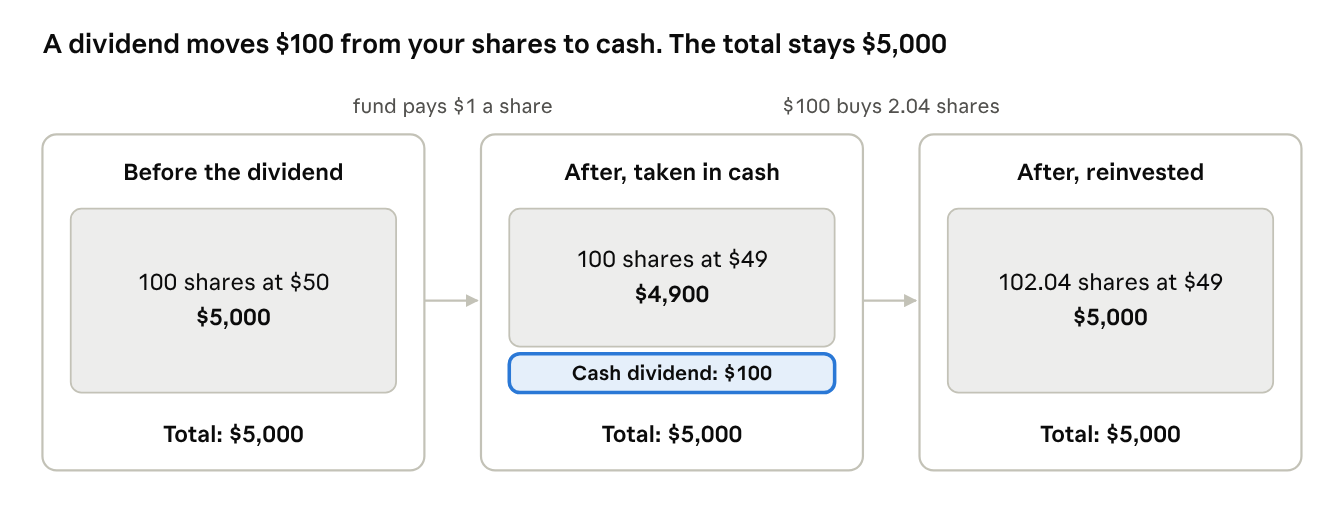 Hypothetical example: one $1-per-share dividend on 100 shares, no market movement
Nothing was created. The fund moved $100 from one of your pockets to the other. Fund companies say so in their own shareholder materials: on the distribution date the share price drops by the amount paid per share, apart from whatever the market does that day (Janus Henderson, Schwab Asset Management).
You rarely notice the drop, because markets move every day and the two changes blend together. It happens all the same.
Reinvesting is a round trip
Most people have dividends reinvested automatically, and many think of that as adding to their investment. Look at the third panel above. The $100 buys 2.04 more shares at the new, lower price of $49. You end with 102.04 shares worth $5,000, exactly where you started.
Reinvesting a dividend is a withdrawal that goes straight back in. Your share count rises, the price per share falls, and the value does not change. No new money entered the account. If you want to invest more, that money has to come from your paycheck or your savings, not from the fund itself.
Reinvesting is still the right choice when you do not need the cash, because it keeps your money fully invested. It just is not saving.
In a regular taxable account, the round trip has a cost. The dividend counts as income for that year whether you take the cash or reinvest it, so you can owe tax on money you never spent. The reinvested amount is added to your cost basis, which lowers the taxable gain when you eventually sell.
Living on dividends is the same as selling shares
Retirees often say they plan to live on their dividends so they never have to sell. It feels like spending the fruit and leaving the tree alone. But since each dividend comes out of the share price, taking a dividend and selling a few shares do the same thing to your account.
Picture two retirees who each start the year with $1,000,000 and each need $30,000 to spend. Both portfolios earn 7% for the year. The first holds funds that pay 3% in dividends and grow 4% in price. The second holds funds that pay no dividend and grow 7%. The first retiree spends the dividends. The second sells $30,000 of shares.
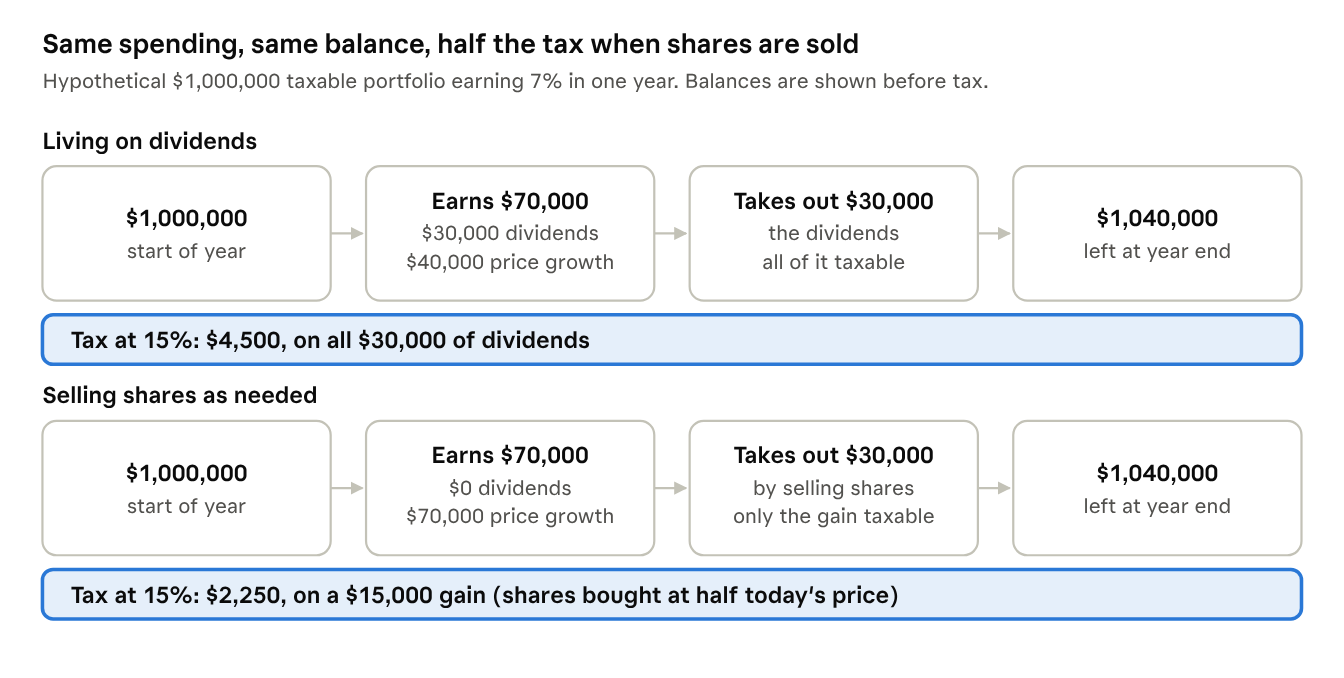 Hypothetical example: two portfolios with the same 7% total return, not actual results
Both spent $30,000 and both have $1,040,000 left. It is the same money. What matters to how long a portfolio lasts is how much comes out and how much the whole portfolio earns, not which label the cash carried on the way out.
The example is simplified, since nearly every stock fund pays some dividend. The point holds at any yield: a dollar taken as a dividend and a dollar taken by selling shares leave you in the same place.
So does it matter which way you do it? Inside an IRA, a 401(k) or the TSP, no. Tax there depends on what you withdraw from the account, not on how the cash was produced inside it.
In a taxable account it does matter, and selling shares usually comes out ahead. All $30,000 of dividends is taxable income for the year. When you sell $30,000 of shares, only the gain is taxed, which is the sale price minus what you paid for those shares. If they were bought at half today's price, the gain is $15,000. Qualified dividends and long-term capital gains, meaning gains on shares held more than a year, are taxed at the same rates (IRS Topic 404). At a 15% rate, the retiree living on dividends owes $4,500 and the one selling shares owes $2,250.
The advantage builds over time. The gains that were not taxed stay invested and keep growing. The seller also decides how much income to take each year, while the dividend investor is taxed on whatever the fund pays, needed or not. The gap narrows as the shares gain more value, but the taxable part of a sale can never be more than the whole amount, which is where every dividend starts. At lower incomes the rate on both can be 0%, and then the difference disappears. Your tax preparer can tell you how this applies to you.
What is a qualified dividend?
A qualified dividend is one that is taxed at the lower long-term capital gains rates (0%, 15% or 20%) instead of your regular income tax rate. Two tests decide it (IRS instructions for Form 1099-DIV):
- Who paid it. The dividend comes from a U.S. corporation or a qualifying foreign one.
- How long the shares were held. You held them for more than 60 days within the 121-day window that starts 60 days before the ex-dividend date. With a fund, the fund has to meet that test on the stocks it owns, and you have to meet it on your fund shares.
For a long-term investor, most of the dividends from a broad U.S. stock fund pass both tests. The usual exceptions are the interest that bond and money market funds pay out under the name "dividends," most dividends from real estate investment trusts, and dividends on shares bought or sold within a couple of months of the payment.
You do not have to work this out yourself. Your Form 1099-DIV shows total ordinary dividends in box 1a and the qualified part of that total in box 1b.
What dividend funds are, and why people like them
Dividend funds pick stocks for their payouts. Some hold the highest-yielding companies. Others hold companies with a long record of raising their dividends. Both kinds are popular, especially with people near or in retirement.
The appeal is real, and it is mostly psychological. Hersh Shefrin and Meir Statman described it in 1984:
- Self-control. "Spend the dividends, leave the rest" is a simple rule that keeps people from overspending.
- Mental accounting. People sort money into income and principal. A dividend lands in the income bucket, so spending it feels allowed. Selling shares feels like eating the seed corn.
- Regret. A dividend arrives without any decision on your part. Selling means choosing what to sell and when, and you can second-guess a choice.
None of that changes the arithmetic. A dividend fund is a stock fund that hands part of your return back in cash on its own schedule.
It is also a narrower stock fund. Choosing companies by their dividends tilts a portfolio toward certain kinds of stocks. Morningstar notes that yield-focused funds land on the value side of the market, and that sectors such as utilities and consumer staples have paid more than technology. Vanguard's researchers found high-dividend funds more concentrated and heavier in defensive sectors than the broad market.
That tilt is where the performance comes from. Dividend stocks have done well over long periods, and people often read that as proof the dividends are what pay. Yin Chen and Roni Israelov tested it on U.S. stocks from 1964 through 2021. Once they accounted for the traits dividend payers tend to share, such as low prices relative to company fundamentals and strong profitability, nothing was left for the dividend itself to explain. If you want those traits in a portfolio, a broadly diversified fund can target them directly without leaving out every company that does not pay much.
Two more cautions. Dividends are not guaranteed. Companies cut them when business turns down, as many banks did in 2008 and 2009, and Morningstar points out that the highest yields often belong to companies whose prospects are weakening. And in a taxable account, a higher yield means more taxable income every year, whether or not you needed the cash.
A better way to think about retirement income
Ask what a portfolio earns in total, not what it pays out. This is called a total-return approach, and it has three steps:
- Decide how much you need from the portfolio each year.
- Hold a broadly diversified, low-cost portfolio at a level of risk you can live with.
- Take that amount on a schedule, such as a monthly transfer to your checking account. Use the dividends and interest that have arrived, and sell shares to cover the rest.
Selling shares this way is no more "dipping into principal" than taking a dividend is. The sales can also do useful work, since trimming whatever has grown past its target keeps the portfolio in balance.
Vanguard's research comes to the same place: set the mix of investments by your goals and your tolerance for risk, and fund spending from income and growth together instead of reaching for yield.
There is nothing wrong with receiving dividends. Every diversified stock portfolio pays some. Just don't choose your investments for them, and don't count them twice. A dividend is your own money coming back to you.
Sources
- Samuel Hartzmark and David Solomon, The Dividend Disconnect, Journal of Finance, 2019
- Hersh Shefrin and Meir Statman, Explaining Investor Preference for Cash Dividends, Journal of Financial Economics, 1984
- Yin Chen and Roni Israelov, Income Illusions: Challenging the High Yield Stock Narrative, Journal of Asset Management, March 2024, as summarized by Larry Swedroe
- Vanguard Research, Total-Return Investing: A Smart Response to Shrinking Yields, April 2021
- Morningstar, How Does Your Passive Dividend Fund Avoid Risky Stocks?
- Janus Henderson, Mutual Fund Distribution FAQs
- Schwab Asset Management, Distribution and Tax Resources
- IRS, Topic No. 404, Dividends
- IRS, Instructions for Form 1099-DIV, qualified dividends
This article is for educational purposes only and does not constitute individualized financial, tax, or legal advice. The examples are hypothetical, use round numbers for illustration, and do not represent the results of any actual investment. Tax rates and rules are subject to change; confirm how they apply to your own situation with a qualified tax professional. Past performance is no guarantee of future results. William Carrington, CFP®, RMA®, principal of Carrington Financial Planning LLC.