
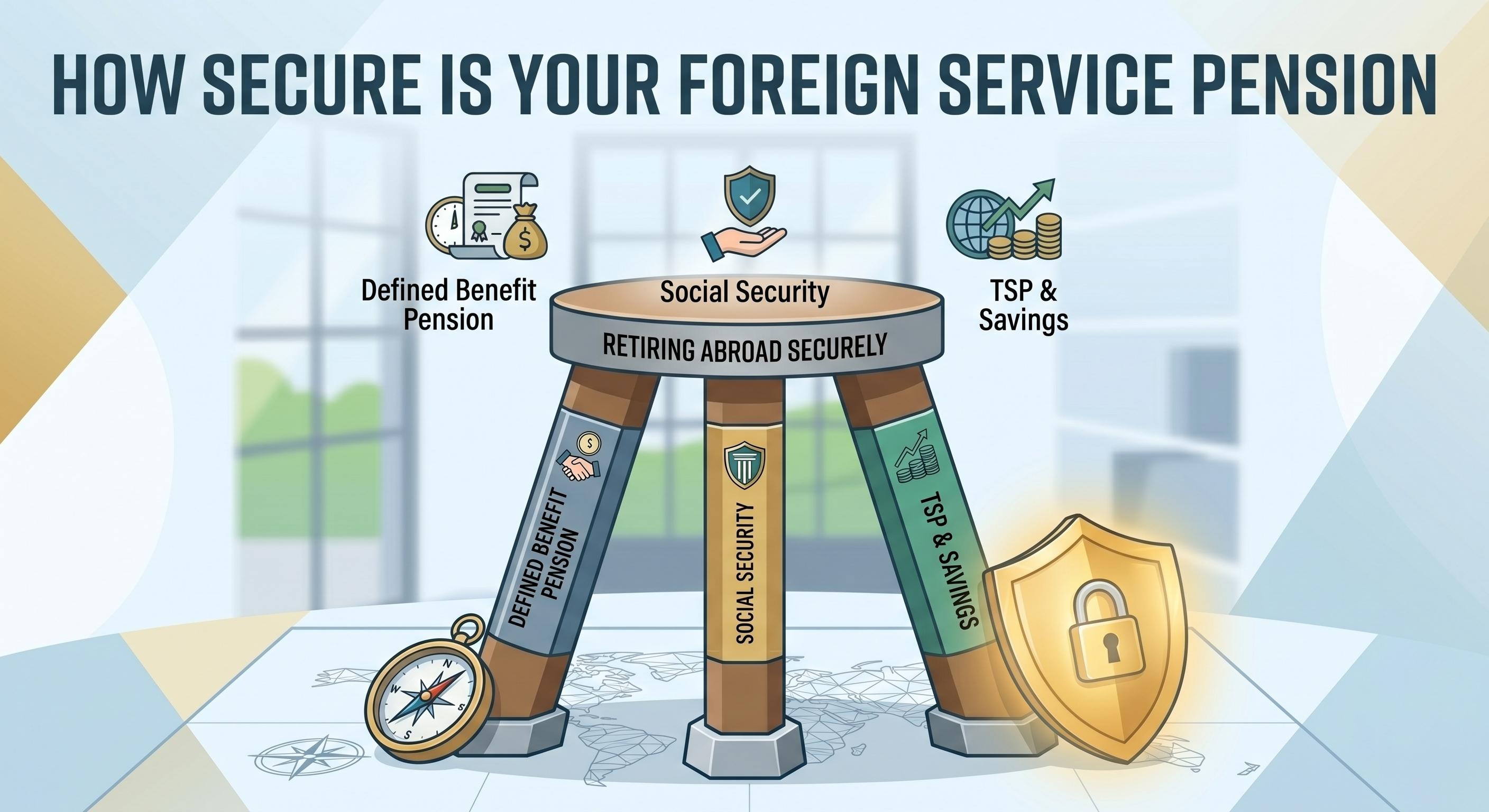
How Secure Is Your FSPS Pension?
Over the past year, more clients than usual have asked me some version of the same question: “Is my FSPS pension actually safe?” Given the workforce turbulence across the federal government and a serious congressional run at federal retirement benefits in 2025, it is a reasonable thing to wonder about — and a question that deserves a careful, factual answer rather than reassurance or alarm.
The short version: on the dimension most people actually worry about — will the checks keep coming? — the FSPS is about as solid as a retirement promise gets. The realistic risks live somewhere else, and they are risks you can plan for. Let me walk through it in three layers, and then close with what the law does and does not protect, since that question comes up as well.
Layer One: Payment Security — Essentially as Strong as It Gets
FSPS annuities are paid from the Foreign Service Retirement and Disability Fund (FSRDF), a trust fund established back in 1924. The fund is built from employee contributions, agency contributions, appropriations, and interest, and its assets are invested in U.S. Treasury securities — obligations backed by the full faith and credit of the United States government.
Two things follow from that structure. First, there is no “underfunded pension goes broke” scenario here of the kind you may have read about with state pensions, municipal plans, or troubled private-sector funds. Your annuity is a legal entitlement of the federal government, and it gets paid the same way Treasury honors its other obligations — regardless of the fund’s balance sheet in any given year. The fund is, in a meaningful sense, an accounting mechanism behind a sovereign promise.
Second, the only true default risk on an FSPS annuity is United States sovereign default risk. If you are comfortable holding Treasury bonds — and nearly every retirement portfolio on Earth is built on the assumption that you should be — you should be comfortable with the payment security of your annuity. They rest on the same foundation.
Layer Two: Legislative Risk — Real, but Read the Fine Print
If payment security is not the issue, what is? Congress. Federal retirement benefits are created by statute, and Congress retains the authority to change them — particularly on a prospective basis, meaning benefits not yet earned. In 2025, lawmakers tried. It is worth walking through what happened, because it is the best real-world stress test we have.
The House-passed version of the 2025 budget reconciliation bill contained several provisions aimed squarely at federal retirement: eliminating the annuity supplement for most employees retiring before age 62, moving the pension calculation from a high-three salary average to a high-five, raising employee contributions to 4.4 percent for longer-tenured employees who had been paying less, and requiring new hires to choose between higher contributions and at-will employment status.
Then three instructive things happened:
- The proposals got softer with each revision. The high-five change and the contribution increase were stripped before the bill even passed the House, after significant pushback from members of both parties.
- What survived was written prospectively. Even the supplement elimination, the most aggressive surviving provision, was drafted to preserve the benefit for anyone already entitled to it — and its effective date was pushed out years.
- And then all of it was dropped. Every federal retirement provision was removed from the bill before Senate passage. None of it became law.
This is consistent with the entire modern history of federal retirement changes. When Congress raised FERS employee contributions in 2012 and again in 2013, the higher rates applied only to people hired after those laws took effect. Existing employees and retirees were untouched. The political and practical norm — not a legal guarantee, but a remarkably durable norm — is that accrued benefits are grandfathered and changes fall on future hires or future accruals.
So yes, legislative risk is real, and 2025 proved these proposals can get further through the process than many people assumed. But it also demonstrated where the guardrails are: prospective application, grandfathering, and a great deal of political resistance to changing the rules on people mid-career.
Layer Three: The Part of Your Benefit That Carries the Most Risk
Here is where Foreign Service readers should pay closer attention than their Civil Service colleagues, because one feature of your retirement carries a disproportionate share of the legislative risk: the annuity supplement.
FSPS members can retire as early as 50 with 20 years of service — far earlier than most Americans — and the annuity supplement is the bridge that approximates your Social Security benefit from your federal career until you reach 62. For an officer retiring at 52 or 55, the supplement can represent a meaningful share of household income for as much as a decade.
Notice what Congress targeted in 2025: not the basic annuity formula’s existence, not benefits in payment — the supplement. It is the perennial line item in budget proposals, precisely because it is less visible to the public and easier to characterize as an “extra.” It survived this round. I would not assume it is the last time it appears in a markup.
The same logic applies, to a lesser degree, to slower-moving levers like cost-of-living adjustment formulas and contribution rates for future service. These are the realistic vectors for change — not your accrued basic annuity.
What the Law Does — and Does Not — Protect
Questions occasionally come up about whether the courts protect federal pensions outright. The legal picture is worth stating plainly, because both halves of it matter.
On one hand, a benefit you are already legally entitled to — including an annuity in payment — is protected by due process against arbitrary administrative action. The government cannot simply cut off an individual’s annuity without notice and a fair process, and a wrongly terminated annuitant has real legal recourse.
On the other hand, that protection runs against agencies, not against Congress. Under a principle the Supreme Court articulated back in 1960 in Flemming v. Nestor — decided in the Social Security context and applied to federal benefits ever since — statutory benefits are not contracts. Congress created these systems and can amend them, particularly prospectively. There is no court decision placing federal pensions beyond legislative reach, and recent Supreme Court pension cases have involved private-sector plans governed by ERISA, a law that simply does not apply to the FSPS or FERS.
In plain English: the courts protect the annuity you have been granted from being arbitrarily taken away. They do not stop Congress from changing the rules for benefits you have not yet accrued. The practical protections for accrued benefits come less from constitutional law than from the political and historical norms described above — which, as 2025 showed, have held.
What This Means for Your Planning
If you take one thing from this post, make it this: the right response to pension uncertainty is not fear, and it is not complacency — it is structure. A few practical implications:
- Stress-test the supplement. If you are within ten years of retirement eligibility, your financial plan should be able to answer the question: “What happens if the supplement is reduced or eliminated for people in my cohort?” If your retirement only works with every dollar of the supplement intact from day one, that is worth knowing now, while you still have levers to pull — TSP savings rate, retirement date, spending design.
- Build a transition cash buffer. Separate from any legislative question, retirement processing across the federal government has slowed considerably, and some recent retirees have waited months for benefits to be fully adjudicated. Interim payments help, but they are partial. Carrying six to twelve months of accessible reserves into your retirement transition is cheap insurance against a paperwork queue.
- Treat your basic annuity as the bedrock it is. When we model retirement income, the FSPS basic annuity sits alongside Social Security as the most reliable income on the page — inflation-adjusted, government-backed, payable for life. Do not let headlines talk you into discounting an asset that strong.
- Stay informed through reliable channels. AFSA and other federal employee organizations did real advocacy work in 2025, and the outcome showed it. Their legislative updates are a far better use of your attention than secondhand speculation.
The Bottom Line
Your accrued FSPS annuity is backed by the same full faith and credit as the Treasury securities at the core of nearly every retirement portfolio in the world. The realistic risk is not that your earned benefit disappears; it is that Congress trims future accruals or ancillary benefits like the annuity supplement — almost certainly on a prospective, grandfathered basis if history is any guide.
That is a risk you can plan for — and planning for it beats worrying about it every time.
This post is for educational purposes only and is not legal or tax advice. Legislative proposals change quickly; the description above reflects the state of play as of June 2026.