
How Secure Is Your Social Security?
This week the Social Security trustees released their annual report, and the headlines wrote themselves: the program’s main trust fund is now projected to run dry in late 2032, a quarter earlier than last year’s estimate. If you read no further than the headline, “insolvent in six years” sounds like the program is collapsing.
It is not — but the report is genuinely important, and it deserves the same treatment I gave the FSPS pension in a recent post: a careful look at what is actually at risk, what is not, and what a Foreign Service household should do about it. The two posts are companions for a reason. Your retirement rests on both systems, and the security analysis for each follows the same logic.
What the Report Actually Says
Three numbers matter. First, the Old-Age and Survivors Insurance (OASI) trust fund — the one that pays retirement and survivor benefits — is projected to deplete its reserves in the fourth quarter of 2032. Second, when that happens, incoming payroll taxes would still cover 78 percent of scheduled benefits. Third, if the retirement fund were combined with the separate disability fund (which would require a change in law, but is the convention for describing the program’s overall health), full benefits could be paid into 2034, with 83 percent payable thereafter. The disability fund on its own is projected to stay solvent for the full 75-year horizon.
Why did the date move up? The trustees point to three things: the 2025 tax law reduced revenue from the income taxation of benefits, and the actuaries lowered their long-term assumptions for both fertility and immigration — meaning fewer future workers paying in. None of these is a sudden crisis; all of them shift a long-known funding gap modestly closer.
What “Insolvency” Does Not Mean
Here is the single most misunderstood point in this entire conversation: trust fund depletion does not mean Social Security stops paying benefits. It does not even mean benefits are cut to zero, or close to it.
Social Security is funded primarily by payroll taxes on current workers, and those taxes keep arriving every payday regardless of what the trust fund balance says. The trust fund is a reserve that has been covering the gap between what the program collects and what it pays out. When the reserve is exhausted, the program reverts to paying out exactly what it takes in — which, per the projections, is 78 percent of scheduled benefits. A 22 percent across-the-board reduction would be a serious blow, and I do not want to minimize it. But “the checks shrink by roughly a fifth unless Congress acts” is a very different sentence than “the program goes bankrupt,” and the difference matters enormously for planning.
It is also worth saying plainly, as I did in the FSPS post: there is no constitutional guarantee here. Social Security benefits are statutory, not contractual — the Supreme Court settled that in 1960 — and Congress can change them. That cuts both ways. It is why a future Congress could trim benefits; it is also why Congress can fix the shortfall, with a wide menu of options for doing so.
The 1983 Precedent — and Why Federal Employees Know It Better Than Anyone
We have run this exact experiment before. In the early 1980s, the trust fund came within months of depletion. Congress acted in April 1983 — late, messily, and under intense pressure — but it acted, and the resulting reforms are instructive.
The 1983 amendments did not slash benefits for people in or near retirement. Instead, the changes were phased in over decades: the full retirement age rose gradually from 65 to 67 in a schedule that took nearly 40 years to fully apply, payroll tax increases were accelerated, and a portion of benefits became taxable for higher-income recipients. The burden fell mostly on younger workers with time to adjust.
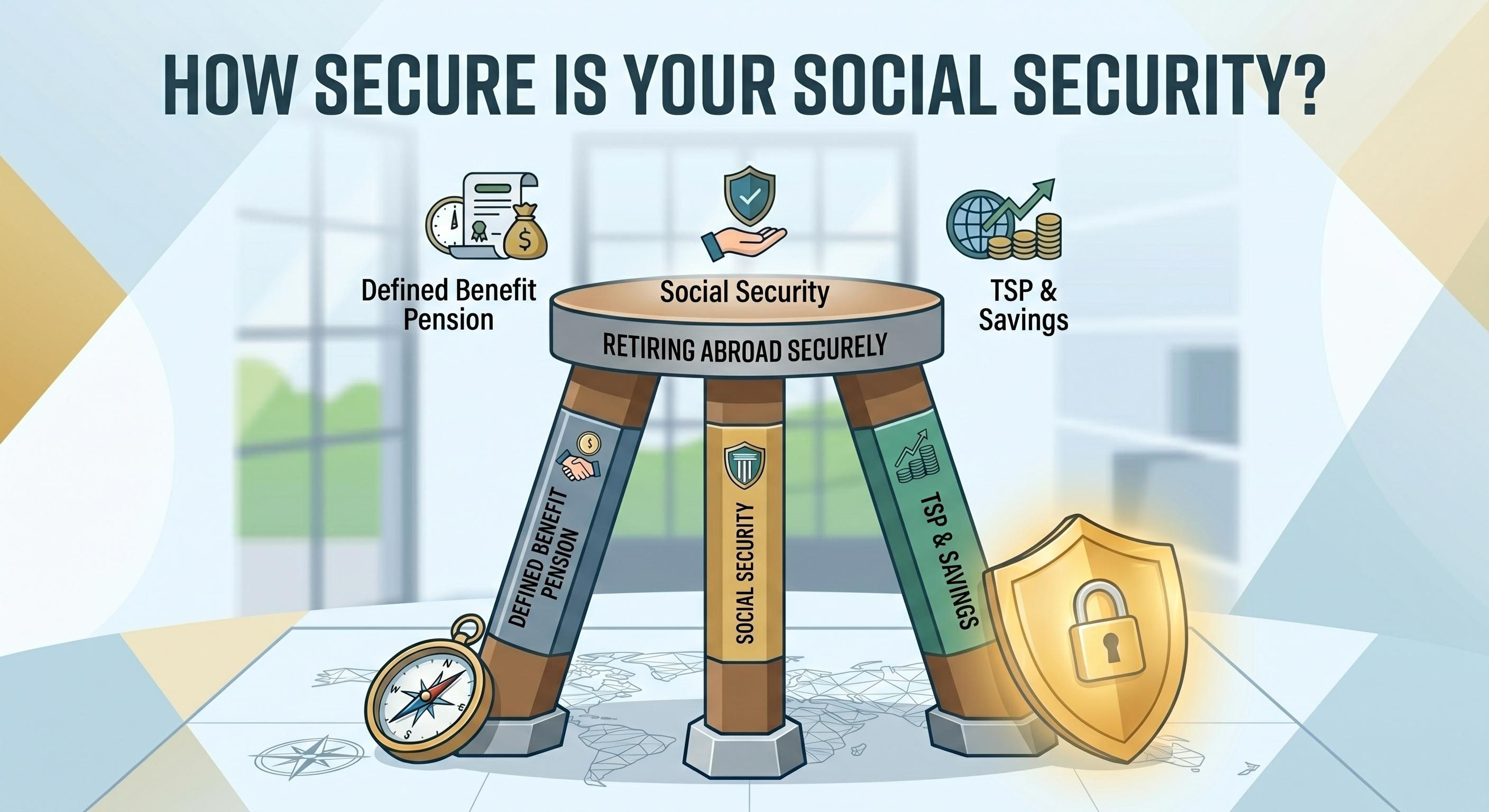
Federal employees should find one of the 1983 reforms especially familiar: it brought all newly hired federal workers into Social Security. That decision is the direct reason FERS — and with it, the FSPS — exists. Your three-legged retirement (annuity, TSP, Social Security) is itself an artifact of the last time Congress repaired this program. The precedent is not a guarantee, but it is the single best evidence we have for how the political system behaves when the deadline becomes real: it protects current and near retirees, phases changes over long horizons, and spreads the cost broadly.
The fixes available this time are well known and have been scored for years — raising or eliminating the payroll tax cap, adjusting the tax rate, further changes to the retirement age for younger workers, modifying the benefit formula or the inflation adjustment, or some blend. What has been missing is not options; it is political will, which historically arrives in proximity to the deadline. The trustees themselves urge action sooner so changes can be gradual. Six years is uncomfortably close, and the 2032 date should be taken seriously — but it is exactly the kind of deadline that has produced action before.
What This Means for Foreign Service Households Specifically
A few angles matter more for FS families than for the average American household.
- You are less dependent on Social Security than most. For a typical American retiree, Social Security is the largest — sometimes the only — source of guaranteed lifetime income. For an FSPS retiree, it sits alongside an inflation-adjusted federal annuity and a TSP balance. A 22 percent Social Security reduction is a real planning event for an FS household, but it is rarely an existential one. That structural diversification is worth appreciating.
- The annuity supplement is a separate question. The FSPS annuity supplement approximates your Social Security benefit between retirement and age 62, but it is paid under its own statute from the retirement fund — not by the Social Security Administration. A trust fund depletion in 2032 would not mechanically reduce your supplement. The supplement’s real risk is legislative, as I covered in the FSPS post, and a broader Social Security reform package is exactly the kind of vehicle where supplement changes could ride along. Two different doors into the same room.
- Watch the spouse’s earnings record. Many FS spouses have interrupted careers — overseas tours, employment gaps, intermittent federal or local-economy work. That can mean a thinner Social Security earnings record, fewer covered quarters, and greater reliance on spousal and survivor benefits, which would also be affected by any across-the-board reduction. Dual-checking both spouses’ earnings records on ssa.gov, and understanding how spousal benefits layer onto the household plan, matters more in this community than most.
The Costliest Mistake: Claiming Early Out of Fear
Every time a trustees report makes headlines, some people respond by claiming benefits at 62 to “get theirs while it lasts.” In nearly every case, this is the most expensive possible reaction to the news.
Claiming at 62 locks in a permanent reduction of roughly 30 percent relative to full retirement age — a guaranteed cut, taken today, to defend against a potential cut that Congress has historically prevented and that, if it ever arrived, would almost certainly be shaped to protect those already receiving benefits. Meanwhile, each year of delay between 62 and 70 buys you more inflation-adjusted lifetime income, and that math is barely dented even in scenarios with a future across-the-board reduction. For most healthy retirees — especially the higher earner in a couple, whose benefit becomes the survivor benefit — delayed claiming remains the right call. Fear is not a claiming strategy.
In our planning work, the better response is to model the uncertainty directly: we can run retirement projections with Social Security at full scheduled benefits, and again with a haircut applied from the early 2030s onward, and see whether the plan still works. For most FS households, it does — and knowing that is worth far more than a headline-driven decision.
The Bottom Line
Social Security is not collapsing, and it is not fine. The honest description is that the program faces a well-understood, fully quantified funding gap with a now-uncomfortably-near deadline, a Congress that has not yet acted, and a forty-year-old precedent for how it eventually will: protect those in and near retirement, phase changes over decades, and spread the cost. Your planning should respect both halves of that sentence — take the 2032 date seriously enough to stress-test your plan against a benefit reduction, but not so seriously that you make a permanent, fear-based claiming decision against a risk that history suggests will be managed.
And if you are a Foreign Service household, take a moment to appreciate the irony: the last great Social Security rescue is the reason your retirement system exists at all.
This post is for educational purposes only and is not legal or tax advice. Projections reflect the 2026 Social Security Trustees Report released in June 2026 and are subject to change.