
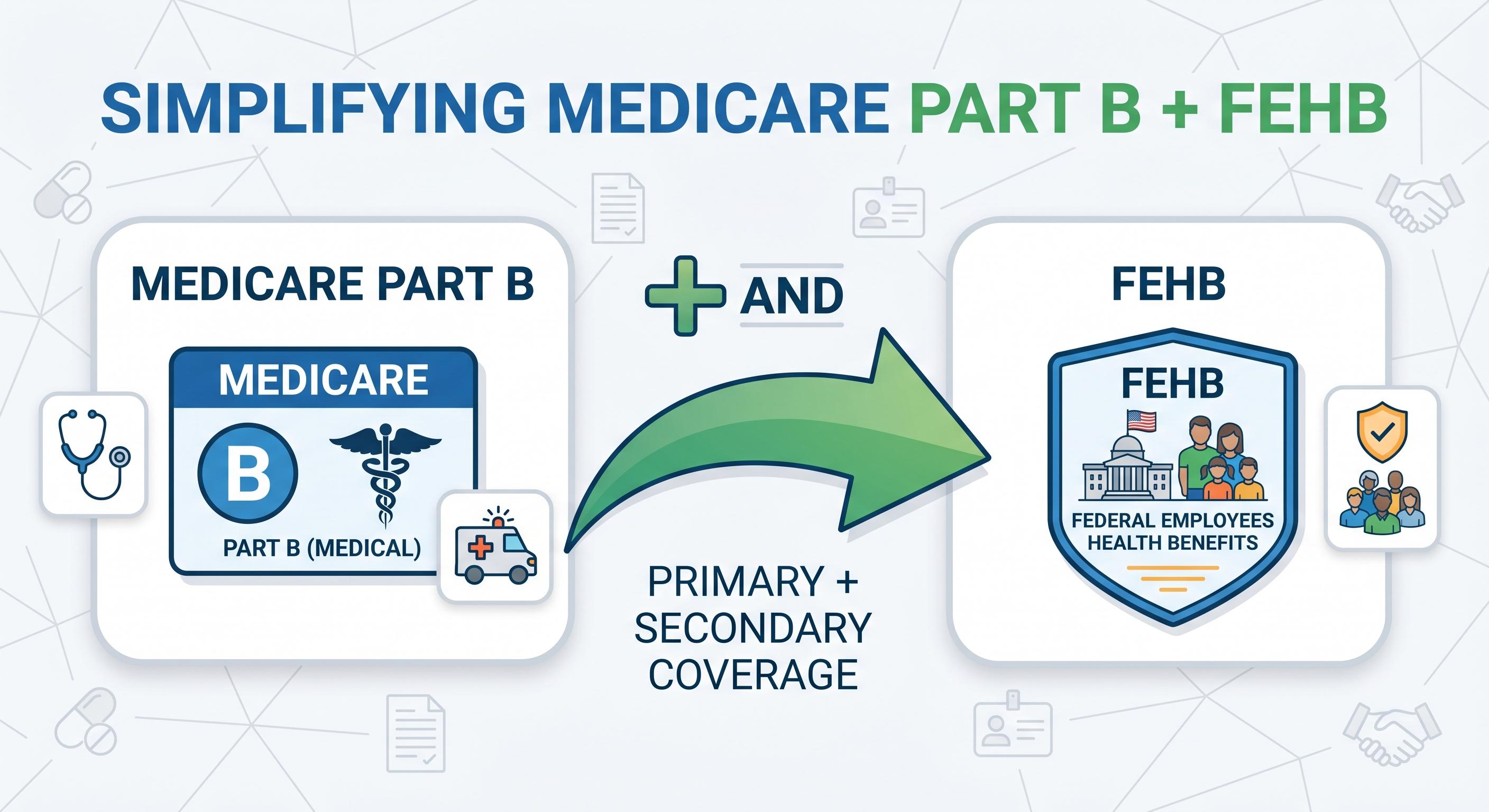
Medicare Part B and FEHB: How to Think About the Decision at 65
Around age 65, every federal retiree with FEHB hits the same fork: do you also enroll in — and pay for — Medicare Part B? Roughly half of federal annuitants do. There’s no universal right answer, but there is a right way to reason through it, and getting the reasoning wrong is expensive in both directions.
The setup
You keep your FEHB in retirement no matter what you do with Medicare. Part A is premium-free for nearly everyone, so enrolling in it at 65 is an easy yes. Part B is the real decision: it carries a monthly premium — $202.90 in 2026 for the standard amount — and it’s optional. The question is whether layering Part B on top of the FEHB you already have is worth the cost.
The case for adding Part B
FEHB and Part B together can sharply reduce what you pay out of pocket. Many FEHB plans waive their deductibles, copays, and coinsurance when Medicare is the primary payer, and a growing number of FEHB plans now reimburse part of the Part B premium or offer Medicare Advantage–style arrangements built around it. If you’re a heavy user of health care, the combination can get you close to first-dollar coverage with very little hassle.
The case for skipping it
Part B is an added premium for coverage that overlaps a lot of what FEHB already provides. If your specific FEHB plan doesn’t meaningfully reward you for carrying Part B — no waived cost-sharing, no premium reimbursement — you may simply be paying twice for similar protection. The decision turns heavily on the details of your particular plan, not on a general rule.
The IRMAA math — the surprise that catches higher earners
If your income is high, Part B costs more than the sticker price. The Income-Related Monthly Adjustment Amount (IRMAA) adds a surcharge on top of the standard premium once your income crosses certain thresholds. For 2026, IRMAA begins above $109,000 (single) or $218,000 (joint) in modified adjusted gross income, and the top tier pushes the Part B premium to $689.90 a month per person.
Three features make IRMAA dangerous to ignore:
- It’s a two-year lookback. Your 2026 premium is based on your 2024 income. Decisions you make now show up two years later.
- It’s a cliff. One dollar over a threshold triggers the entire surcharge for that tier.
- It’s per person. For a couple, both spouses pay, so the combined Part B cost in a high tier can run well over $1,000 a month.
Because your pension, TSP withdrawals, and any Roth conversions all feed MAGI, the Part B decision is really a tax-planning decision wearing a health-insurance costume. A large Roth conversion at 63, for instance, can quietly raise your Medicare premiums at 65.
The Foreign Service angle that can flip the whole decision
Here’s a factor most general guidance ignores: Medicare generally doesn’t pay for care received outside the United States. FEHB does cover overseas care. A Foreign Service retiree who plans to live abroad — or spend large parts of the year overseas — gets very little from Part B, because the coverage won’t follow them where they’re using it. They’d be paying a monthly premium for a benefit that mostly sits idle.
For the retiree settling stateside, the calculus is the opposite, and Part B often earns its keep. So “where will I actually receive care?” belongs near the top of this analysis for Foreign Service families, in a way it doesn’t for most retirees.
The late-enrollment trap
One reason not to treat this as a “decide later” question: if you skip Part B at 65 and want it afterward, you generally face a permanent late-enrollment penalty — an added 10% on your premium for each full 12 months you could have had it. Critically, retiree FEHB does not count as the kind of current-employment coverage that lets you delay Part B penalty-free; that exception is for people still actively working under an employer plan. So “I’ll add it later if I need it” is usually an expensive plan. Confirm your specific enrollment window, but treat the decision at 65 as largely now-or-pay-more-forever.
The bottom line: there’s no default answer, but the inputs are knowable — your FEHB plan’s Medicare coordination, your income and IRMAA exposure, and where you intend to live in retirement. Run those three before you enroll, not after.
Carrington Financial Planning is a fee-only fiduciary firm that primarily serves Foreign Service and federal employees. This post is educational and not individualized financial or insurance advice; Medicare rules and FEHB plan terms change, so confirm current details before deciding.