
The Foreign Earned Income Exclusion: What Foreign Service Families Need to Know Before Claiming It
If you spend any time in Foreign Service spouse groups online, you've seen the question. Someone's spouse just landed a remote job with a company back in the States, or started freelancing from post, and a well-meaning commenter replies: "Don't worry about US taxes — you get the foreign earned income exclusion. First $130,000 is tax-free."
That answer is sometimes right, often wrong, and almost always incomplete. The Foreign Earned Income Exclusion (FEIE) is real, and for the right family it's one of the most valuable provisions in the tax code. But it comes with eligibility tests that are unusually tricky for diplomatic families, and — this is the part almost nobody mentions — claiming it can cost you other benefits worth more than the exclusion saves.
This is a long post, because the topic deserves it. Here's the honest disclaimer up front: I am a financial planner, not a CPA. What follows is my best research into the statute, the regulations, IRS guidance, and the excellent annual AFSA Tax Guide — but it is educational information, not tax advice. Before you claim (or skip) the FEIE, talk to a CPA who knows Foreign Service returns. Your facts will differ from every example below.
What the FEIE actually is
The FEIE, found in Section 911 of the tax code, lets a qualifying American exclude foreign earned income from US federal income tax — up to $130,000 for the 2025 tax year (the returns most people filed this spring) and $132,900 for the 2026 tax year. The cap adjusts for inflation each year.
Three things to understand before anything else. First, it's per person, not per household — if both spouses have qualifying foreign earned income, each can claim their own exclusion. Second, it applies only to earned income: wages and self-employment income for work you actually performed. Investment income, rental income, pensions, and capital gains don't qualify no matter where you live. Third, it's an exclusion you claim on a filed return — Form 2555 attached to your 1040 — not an exemption from filing. Your worldwide income still gets reported; the exclusion then removes the qualifying portion from tax.
One more mechanical point that surprises people: excluded income still "fills up" your bottom tax brackets. Whatever income remains taxable gets taxed at the rates that would have applied if the exclusion didn't exist. The FEIE removes income from tax; it doesn't reset your bracket.
Rule one: an embassy paycheck never qualifies
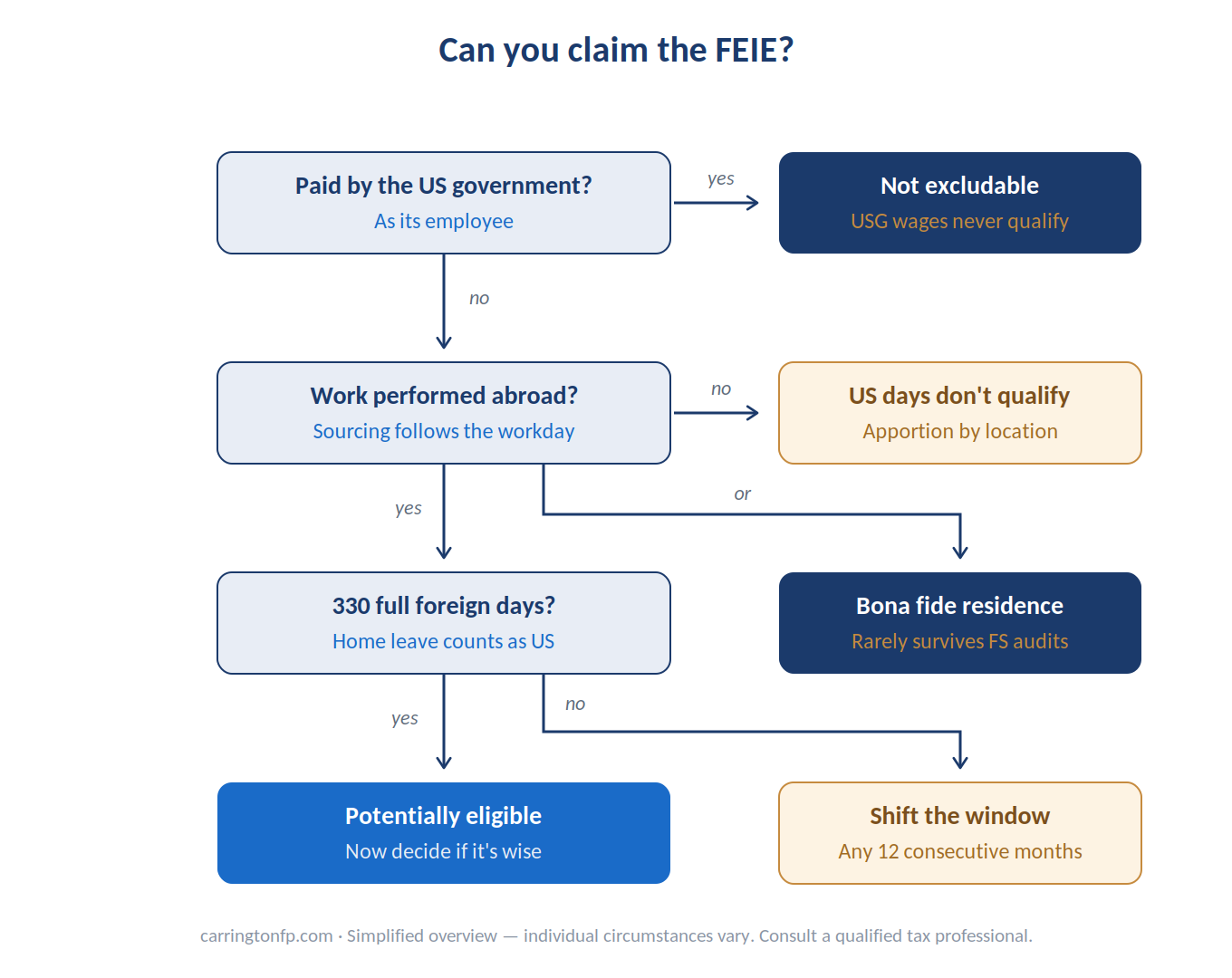
The statute is blunt on this point: wages paid by the US government to its employees are not "foreign earned income," full stop. This applies government-wide — State, DOD civilians, every agency — and it's why the FSO's own salary never qualifies, no matter how many years the family spends overseas.
It also answers the most common EFM version of the question. If you work inside the mission — an EFM position at the embassy or consulate, paid by the US government — that income cannot be excluded. Ever. The FEIE conversation is only relevant for income earned outside USG employment.
Rule two: what matters is where you work, not who pays you
Here's the rule that matters most for the growing community of EFMs working remotely: the tax code sources compensation for personal services to the place where the services are performed. Not where your employer sits, not where your paycheck is deposited, not what currency you're paid in.
So an EFM at post in Lisbon working remotely for a Denver marketing firm is earning foreign source income, because the work happens in Portugal. The same is true for a freelancer at post serving US clients. That income is potentially excludable — if the eligibility tests are met.
The flip side cuts too: days you work while physically in the United States — on home leave, R&R, or an extended visit — produce US-source income for those days, which cannot be excluded. For someone who works through a long summer stateside, the income may need to be split by where each workday happened.
The eligibility tests — and why they're harder for diplomatic families
To claim the FEIE you need all three of the following: a tax home in a foreign country, a passing grade on either the bona fide residence test or the physical presence test, and a Form 2555 filed with your return.
Your tax home is essentially your main place of work. For an EFM living and working at post, that's generally the host country — though the IRS adds that you can't have a foreign tax home for any period your "abode" remains in the United States, which is one reason a paper trail of actually living your life abroad matters.
The two tests are where Foreign Service families run into trouble, so let's take them one at a time.
The bona fide residence test: a poor fit for diplomatic life
The bona fide residence test asks whether you've genuinely made your home in the foreign country for an uninterrupted period covering at least a full calendar year. It's a facts-and-circumstances judgment: your intentions, your ties to the country, whether you pay local taxes, the nature of your visa and your stay.
Now think about how a diplomatic posting looks under that lens. You arrived on government orders for a defined two-or-three-year tour. You live in government-provided or government-leased housing. You hold a diplomatic visa. Under the Vienna Convention, you and your family are generally exempt from host-country income tax. Everything about the arrangement announces that you are temporarily present and intend to leave.
There's also a specific statutory trap: if you've made a formal statement to the host country's authorities that you are not a resident, and they've agreed you're not subject to their income tax as a resident, the law flatly bars you from bona fide residence status. To be precise — because precision matters here — a treaty-based tax exemption by itself does not automatically disqualify you; the IRS says so directly. But the combination of facts that comes standard with diplomatic life makes this test an uphill climb.
This isn't theoretical. AFSA has reported that IRS auditors have actually denied the FEIE to Foreign Service spouses and dependents who claimed it under the bona fide residence test, on exactly these residence and tax-home grounds. And AFSA's guidance notes what has worked instead: the physical presence test, backed by good records.
The physical presence test: the practical path — with a Foreign Service-shaped trap
The physical presence test is arithmetic, not judgment: you must be physically present in a foreign country or countries for at least 330 full days during any 12 consecutive months. A "full day" runs midnight to midnight, and travel days that touch the United States generally count as US days.
Three hundred thirty days out of 365 leaves you a budget of 35 days in the States. That sounds generous until you remember what Foreign Service life requires.
Home leave isn't optional — it's ordered under the Foreign Service Act, and the law requires it be taken in the United States or its territories. (And for this purpose, US territories don't count as foreign countries either.) Congressional intent is literally to reacquaint you with America; the tax code counts every one of those days against your 35.
Now, home leave doesn't come around every year — it's tied to transfers, typically every two to three years, and most officers are granted only the basic mandatory period, not everything they've accrued. That actually sharpens the problem rather than softening it: the risk concentrates in transfer years. Run the numbers on one. A basic home leave of two to three weeks is roughly 20 days or more in the States once you include the travel days on each end. Add a holiday trip to see grandparents that same year — call it two weeks — and the family is at 34 or 35 US days, dead even with the budget, before counting a wedding, a college visit, or a medical trip. In an ordinary year the physical presence test is usually comfortable; in a transfer year it can fail by accident.
There are two pieces of good news. The 12-month window is chooseable: it's any 12 consecutive months, and it doesn't have to match the calendar year. A family whose US days cluster in one summer can often slide the measurement window so that a qualifying 330-day period still exists, with the exclusion prorated for the portion of the tax year it covers. This is fiddly and absolutely worth doing with professional help. And second, if your post is evacuated — something too many families have lived through recently — the IRS publishes an annual list of countries where the minimum-time requirements are waived for people forced to leave by war or civil unrest, provided you could reasonably have expected to qualify had you stayed.
Whatever your situation, the audit-tested advice is the same: keep contemporaneous records. Travel dates, tickets, passport stamps, visas. If the IRS asks, a reconstructed calendar is a weak answer; a running log is a strong one.
The surprise list: what claiming the FEIE costs you
If the eligibility rules are the part people get wrong, this next part is the part people don't know exists. The FEIE removes income from income tax — and only income tax. Several other parts of the tax code keep right on going, and a few actively punish you for claiming the exclusion.
Self-employment tax survives in full
Self-employed people pay two separate taxes: income tax, and self-employment tax — the freelancer's version of Social Security and Medicare, 15.3% on net earnings. The FEIE only touches the first one.
Say an EFM in Nairobi runs a freelance design business netting $60,000 and qualifies under the physical presence test. She excludes all $60,000, and her federal income tax on it is zero. Her self-employment tax is still roughly $8,500. Many self-employed EFMs discover this at filing time, because "my income is excluded" turns out to mean half of what they assumed. The one silver lining: those SE tax dollars buy her own Social Security earnings credits — not nothing for a spouse whose career mobility has already dented her Social Security record. (For EFMs paying into a foreign social security system through local employment, US "totalization" agreements with certain countries can change which system collects — a country-specific question for your CPA.)
It can forfeit the refundable child tax credit
The child tax credit has two components: the regular credit — worth up to $2,200 per qualifying child for 2025 returns — and a refundable portion, the Additional Child Tax Credit, that pays out even when your tax bill is already zero. The Form 2555 instructions are explicit: if you claim the FEIE, you cannot take the refundable portion. For 2025 returns that refundable piece is worth up to $1,700 per child.
Picture a family where the EFM excludes her entire $70,000 remote salary, and between the exclusion and their deductions the family owes little tax. With three qualifying children, the refundable credit could have been worth several thousand dollars in actual cash — and claiming the FEIE forfeits it. For some families, the exclusion saves less than the credit it destroys. This is the single best argument against the "always claim the FEIE" folklore: sometimes the math says don't.
It disqualifies you from the Earned Income Tax Credit
Shorter and blunter: file Form 2555, and you are ineligible for the EITC for that year, period. This bites fewer Foreign Service households given FSO salary levels, but for junior families or a year with unusual circumstances it belongs on the checklist.
Excluded income can't fund an IRA
You can only contribute to an IRA if you have "compensation" — and income you've excluded under the FEIE doesn't count. An EFM who earns $50,000 and excludes all of it has, in the IRS's eyes, zero compensation. Her own earnings cannot support an IRA contribution that year, even though she worked all twelve months.
For married couples there's a rescue: the spousal IRA. The FSO's government salary — which was never excluded, because it never qualified — provides the compensation that supports IRA contributions for both spouses, subject to the usual limits. The retirement savings still happen, but only by way of the marriage. And one wrinkle worth knowing: the income limits for Roth IRA contributions are tested on a modified income figure that adds excluded FEIE income back. You can't use the exclusion to duck under the Roth threshold.
Revoking it locks the door for five years
Claiming the FEIE is an election that stays in effect year after year until you revoke it. And if you revoke it — say, because the family moved from a no-tax post to a high-tax country where the foreign tax credit became the better tool — you cannot claim the FEIE again for five tax years without asking the IRS's permission, which means an expensive private ruling.
For a career that changes countries every two or three years, this transforms the FEIE from an annual checkbox into a genuinely strategic decision. The election that's optimal in Riyadh may be a liability in Paris, and the five-year lock means you can't simply toggle back and forth. Model a few years ahead, not just this return.
A different calculation for EFMs working on the local economy
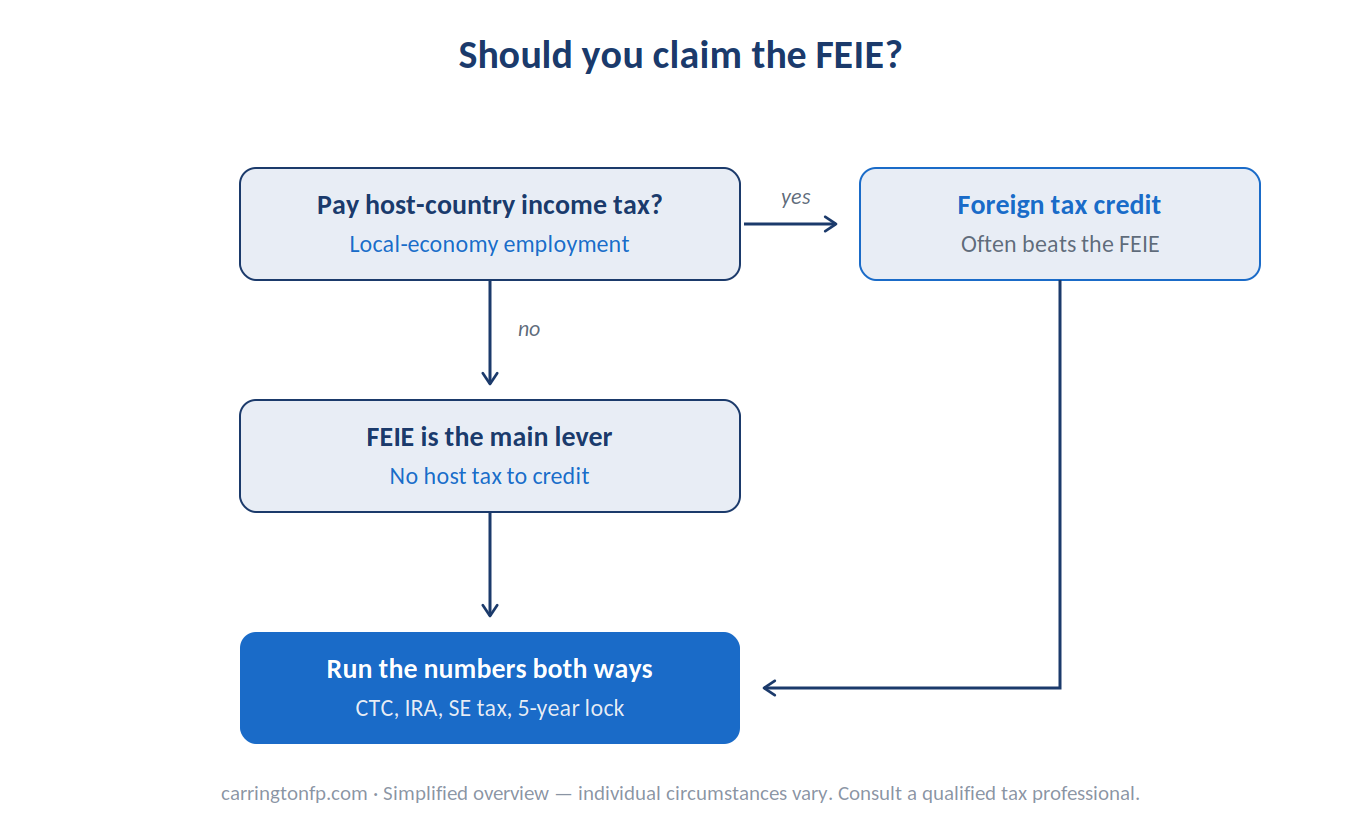
Everything above leans toward EFMs whose income is untaxed by the host country — remote workers and freelancers shielded by diplomatic status. EFMs employed by local companies under bilateral work agreements are usually in a different position: taking that job typically means the immunity is waived for that employment, and host-country income tax and social contributions may apply.
Once you're actually paying foreign income tax, a second US tool enters the picture: the foreign tax credit, which offsets US tax dollar-for-dollar with foreign tax paid on the same income. In a high-tax host country, the credit often beats the exclusion — and it comes without the baggage: it doesn't forfeit the refundable child tax credit, the income still counts as IRA compensation, and there's no five-year lock. In a low-tax or no-tax country, the FEIE usually wins. You generally can't use both tools on the same dollars, so this is a genuine fork in the road — and given the revocation rule, one to choose carefully.
Local employment also tends to create foreign bank accounts and sometimes foreign pension rights, which carry their own US reporting obligations (the FBAR and related forms) with penalties wildly out of proportion to the paperwork. The AFSA Tax Guide covers that territory well, and I'll point you there rather than duplicate it.
What to actually do
If you or your spouse earns non-government income at post, here's the sequence I'd suggest. Start a travel log today — every arrival and departure, kept as you go, with tickets and passport stamps retained (and where a passport isn't stamped, boarding passes and itineraries fill the gap). Before filing season, have a CPA who knows Foreign Service returns run your numbers both ways: FEIE and no-FEIE (or FEIE versus foreign tax credit, if you're on the local economy), including the child credit, IRA eligibility, and self-employment tax in the comparison. Look at the election over your next several assignments, not just this year, because of the five-year revocation lock. And use the physical presence test with documentation rather than bona fide residence unless a professional tells you your facts are unusually strong — the audit history in our community argues for it.
The FEIE is a fine tool. It's just not a magic switch that makes income disappear — and in a Foreign Service life, with its mandated home leave, moving tax environments, and one-career pension math, it deserves more care than a Facebook comment can give it.
A final word on sources and limits: I'm a CFP® professional, not a CPA or tax attorney, and this article reflects my own research into Section 911, the regulations, IRS guidance, and the AFSA Tax Guide — a resource every AFSA member should bookmark. Tax outcomes turn on individual facts, and the rules and dollar amounts change. Please consult a qualified tax professional about your own situation before making any filing decision. Nothing here is tax, legal, or individualized investment advice.